COVID-19: updates for Canada’s universities
Lifting of vaccine requirement at some Ontario universities.
Editor’s note: please note that this page will be updated on an as-needed basis.
May 4, 2022
Lifting of vaccine requirement at Waterloo region universities
As of May 1, three postsecondary institutions – the University of Waterloo, Wilfrid Laurier University, and the University of Guelph – will no longer require proof of vaccination to enter or work on campus, according to CTV News. The three universities have all chosen to maintain their masking policy for indoor spaces.
In Quebec, McGill University has announced the end of its mask mandate, beginning May 24, according to the Montreal Gazette. Concordia University and Université de Montréal will maintain their mask requirement through the summer term. The province recently announced that masks will not be necessary in public spaces beginning May 14.
April 27, 2022
Universities extend masking requirements
The University of Windsor and Trent University have both announced the extension of their indoor mask mandate until the end of May, while the University of British Columbia has chosen June 30. On the East Coast, Memorial University will be lifting indoor capacity limits beginning in the Spring semester, although vaccination and indoor masking policies will remain in place.
A complaint against the University of Guelph’s vaccination policy has been dismissed by the Human Rights Tribunal of Ontario, according to the Toronto Star. The complainant said that the university “discriminated against them… by the introduction of a mandatory vaccine policy for entry to their facility.” The Human Rights Tribunal of Ontario determined that the issue was outside its jurisdiction.
April 20, 2022
Mask mandates return
Students at the University of Ottawa have expressed fear and frustration with the institution’s decision to end its mask and vaccination mandates on May 1, according to the Ottawa Citizen. The city is currently in a midst of a sixth wave, and wastewater indicators show record-high indicators of COVID-19 in the last few days. Carleton University has taken a different direction and has asked students to maintain wearing masks until further notice, while Queen’s University has extended its mask mandate until the end of May.
CTV News has reported that there were over 400 positive cases of COVID-19 reported in the first two weeks of April at the University of Saskatchewan, leading administrators to require masking until the end of June.
Elsewhere, students at Ryerson University have filed a lawsuit against the institution over its vaccine mandate, according to the Western Standard, saying that the mandate caused them to lose campus jobs, scholarships and peace of mind.
April 13, 2022
Exam season amid the variants
Postsecondary students in Ontario are heading into in-person exams this month, despite the rising sixth wave of COVID-19 across the province. Ryan Gregory, a professor of evolutionary biology at the University of Guelph, spoke to the Toronto Star about how students are juggling multiple stressors during exam season, and now have undue stress for fear of catching COVID-19.
And, as graduation rounds the corner, education advocates are warning about the long-term impacts of the pandemic on next year’s incoming university students. Laurie French, president of the Canadian School Board Association, told CBC News that students’ education outcomes during the pandemic has varied widely across the provinces and depending on the student’s life at home, and that learning was especially difficult for those living in remote or rural communities with poor connectivity. “There’s going to be a widening gap for those children,” said Ms. French.
April 6, 2022
Despite sixth wave, more Ontario universities move to end restrictions
Ontario has marked its highest COVID-19 test positivity rate since mid-January, with hospitalizations up 30 per cent, according to CBC News. However, more Ontario universities have announced the end of masking and vaccination requirements on May 1. The University of Guelph, Wilfrid Laurier University, and Carleton University – which has seen a recent outbreak of 221 cases – have all made the move.
However, Brock University has gone in the opposite direction, choosing to maintain its masking and vaccine measures into the Spring semester, and will also be providing rapid antigen tests, medical masks and KN95 masks to students, staff and faculty.
March 30, 2022
Quebec sees outbreaks among students, Ontario lifts masking and vaccine requirements
The director of the Université Laval medical program notified students on Tuesday that there had been a COVID-19 outbreak, indicating that class would not resume in person until April 1. A university spokesman told CBC News that the number of students infected was unknown, and that the spread came as students gathered off campus. This follows a surge in COVID-19 cases at McGill University, where the Montreal Gazette reported that students were breaking isolation to collect meals in dining halls, due to a shortage of isolation rooms. Quebec is currently seeing a rise in COVID-19 infections and hospitalizations following a two-month decline.
In British Columbia, the University of Victoria’s senate voted 23-19 in favour of reinstating an on-campus mask mandate, but its board of directors declined to accept the recommendation, according to CHEK News. The university is recommending that students continue to mask indoors but is not making it a requirement.
The University of Ottawa, Queen’s University, the University of Toronto, and Ryerson University have recently announced that they will suspend masking and vaccination mandates on May 1, the first day of spring semester. The announcement follows the province’s lifting of mask mandates in most indoor places on Mar. 14.
March 23, 2022
Universities announce lifting of mask mandates, vaccine requirements
On May 1, several universities across Canada will remove their mask mandates and proof of vaccination requirements. Wilfrid Laurier University, the University of Ottawa and the University of Guelph have all made the announcement, while strongly recommending that students continue to mask while on campus. CTV News reported that Carleton University has extended masking and vaccine requirements until at least the end of the Winter term.
In Quebec, Concordia University and McGill University will both continue to enforce mask mandates throughout the semester, while the Université de Montréal says it has not yet decided. The province plans to remove mask mandates by April, according to CTV News.
Manitoba’s two largest universities, the University of Manitoba and the University of Winnipeg, both plan to lift vaccine requirements in the spring but are continuing with their masking policy, according to CBC News.
Mount Royal University has lifted its masking mandate, following the directive from the province, but students are arguing that the university should be able to make its own health and safety policies to protect vulnerable students and their families.
March 16, 2022
To mask, or not to mask?
In a statement released last Friday, the Council of Ontario Universities announced that the province’s universities will maintain their masking requirement until at the least the end of the semester, according to the Toronto Star. The province is preparing to lift its mask mandate on March 21.
Albertan universities have made the opposite move, with students and staff at the University of Alberta and MacEwan University no longer required to mask up, following the province-wide decision to end masking on March 16. The University of Alberta students’ union said it plans to fight the policy, after a survey showed 61 per cent of students want to continue wearing masks.
Students at Simon Fraser University have also launched a petition to oppose the university’s recent move to drop its mask mandate, whereas the University of British Columbia has chosen to maintain mask wearing until the end of the spring semester. British Columbia removed the mask mandate for indoor public spaces on March 11.
On the East Coast, Cape Breton University is the only Atlantic university that is dropping its face mask policy, and CBC News reported that many faculty are worried about the decision. Nova Scotia will end mask mandates at the same time as Ontario, on March 21.
Something to celebrate
After two years of students attending virtual convocations, pandemic graduates from the classes 2020, 2021 and 2022 will be able to gather in person for convocation at the University of Waterloo and Wilfrid Laurier University, according to The Record.
March 9, 2022
Online learning during pandemic leaves some students wanting more
Remote learning options used during the pandemic offer more flexibility and accessibility for some students, which may be forcing universities to reimagine how they structure courses. According to CBC News, students with disabilities, anxiety disorders and socioeconomic issues benefit from online programs, which are expected to see enrollments rise in the coming years. While the online model isn’t new, universities are experimenting with novel technologies like mixed reality to enhance the online learning experience for students of all abilities.
Students prepare for campus life in Manitoba
Brandon University is preparing for a full return to campus for fall 2022, with the lifting of all COVID-19 restrictions at the university through the spring and summer. In a statement to CBC News, Brandon University president David Docherty cited extreme levels of vaccination on campus and in the community, as well as hopeful projections for the health care system throughout the coming months. The University of Manitoba, however, is likely to make an announcement about a return to campus in the summer term in the weeks ahead.
March 2, 2022
Universities extend vaccine mandates, despite lifting of restrictions
More universities have announced that their vaccine requirements and other COVID-19 health measures will remain in place until at least the end of the winter semester. St. Thomas University’s vice-chancellor wrote to the student community that it will maintain its protection measures, including masking and physical distancing requirements, despite the province of New Brunswick lifting its restrictions on March 14, according to CBC News. UPEI will also be keeping its mandatory vaccination requirements and plans to re-evaluate its policy in the spring.
University students have mostly returned to class in Ontario, with CTV News reporting that both staff and students at Western University are glad to be back. At Brock University, however, a handful of students advocated for more online learning options, hoping to bring attention to what they believe to be “unsafe conditions” at the St. Catharine’s campus, according to the Niagara Falls Review.
Unvaccinated staff put on unpaid leave
At the University of Waterloo, there has been a series of staff terminations after the school chose to mandate COVID-19 vaccinations. The Record reported that the terminations came after the province announced it would be removing requirements for mandatory vaccine policies in the workplace. The professors have been placed on unpaid leave.
Read archived updates from previous months:
February 2022
January 2022
December 2021
November 2021
October 2021
September 2021
August 2021
July 2021
June 2021
May 2021
April 2021
March 2021
February 2021
January 2021
December 2020
November 2020
October 2020
September 2020
August 2020
July 2020
June 2020
May 2020
April 2020
March 2020


Featured Jobs
- Architecture - Assistant Professor (Digital Fabrication, Design Computation, and Design/Build)Laurentian University
- Music - (4) Assistant Teaching Professors (String Quartet)University of Victoria
- KAUST Global Fellowship Program - Postdoctoral Fellowship (Call 2027)King Abdullah University of Science and Technology
- Public Law - Assistant or Associate ProfessorUniversity of Ottawa
- Director, Human Research Ethics & Strategic AdvisorUniversity of Manitoba
More from News
-
Attacks on higher education spread globally, including in liberal democracies, Scholars at Risk report finds
Canada urged to defend values amid erosion of institutional autonomy in the U.S.
-

Grad student visas double since 2025
Policy changes drive sharp rise in permits for international master’s and PhD candidates.
-

Where do Quebec’s political parties stand on higher education?
With the provincial election less than a month away, we provide a roundup of platforms and promises.
-

Kids with wealthy grandparents more likely to attend university
High-income grandparents can compensate for low-income parents in higher-ed access, a recent study shows.
More from COVID-19
-

How work has changed for university vaccine researchers
COVID-19 led to new opportunities and challenges.
-

Did COVID kill creativity?
The pandemic became a rare chance for academic creatives to witness the power of imagination and why it matters.
-
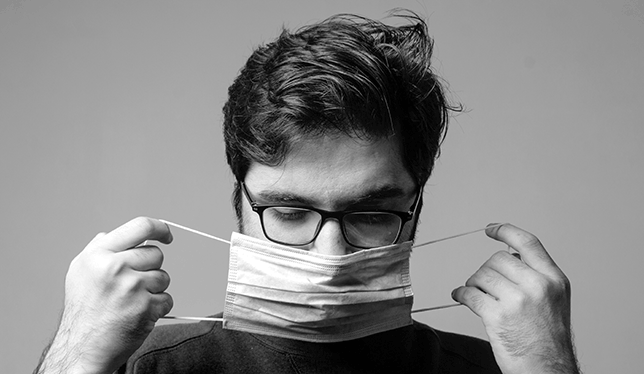
Seeing and being seen from behind a mask
A dean’s private grief has inspired reflection and changed her leadership.
-

The quest for more vets
How universities are responding to a country-wide shortage.
More from Articles
-

Ottawa extends successful program to recruit French-speaking international students
Minority communities, universities, benefit from demographic boost of young francophones.
-
Ottawa announces 64 new research chairs in international talent attraction strategy
Top-tier researchers from 13 countries to join Canadian universities in first wave of appointments.
-

Level Up Learning
Amélie Vallières investigates how story-driven video games can support learning and build identity.
-
A look inside the hive: celebrating honey bee research at two Canadian universities
As MacEwan University marks 10 years of bees on campus, the University of Guelph kicked off the year by unveiling its newest centre for honey bee research.

Post a comment
University Affairs moderates all comments according to the following guidelines. If approved, comments generally appear within one business day. We may republish particularly insightful remarks in our print edition or elsewhere.
27 Comments
It is my believe; Since every University has their own opinion rules and their mandatory elements, etc. according to vaccination.
Neither to say not all students are vaccinated as well.
It can be for religion, health purposes or simply believes etc..
Therefore, the control to stop the speeding or trans passing different variants, viruses it will be impossible. Regardless if they are vaccinated every organism reacts differently.
I am a mother of two University students and they are vaccinated even I don’t think they will be in a safe environment surrounded by thousand of students without the unknown …
… It happens or it will happen? Just to have or roll the economy and making money no matter the consequences?
Sharing my thoughts and my concerns at the end would be a very high price to pay!
Will natural immunity be acknowledged? Recent science has supported evidence that those individuals who have been infected or had asymptomatic Covid exposure produce long lasting memory t cell protection. According to The Journal of Infectious Diseases protection is currently known to last up to 11 months.
Since Sars Covi 2 has been circulating for over 1 1/2 years, and know to be mild or asymptomatic in most healthy young adults, would it not be a reasonable assumption that many of these people have immunity through natural exposure?
It appears it is fear not science driving the need to mandate an emergency use vaccine against a virus that has a 99% survival rate for healthy young people. If you are requiring students to be in the vaccine trial for immunity sake, shouldn’t schools also acknowledge through testing, natural immunity, if it really is about health?
Excellent questions and important points! It is as though science and critical thinking have been thrown out the window entirely in response to Covid-19. Mass hysteria rules the day. Cancel culture destroys Western civilisation, as we all cower for fear of being cancelled or de-platformed. At what cost? These vaccines haven’t existed long enough to complete the full clinical trial process. We don’t know the long term effects or individual risk factors. Where are all the sanctimonious Human Research Ethic Boards members now? Nuremberg Code ring a bell? UN’s Universal Declaration of Bioethics and Human Rights? Canada has signed both.
University students do not live in an isolated bubble. They have grandparents, parents, and family members who they can infect without realizing it. Some of them will may get seriously ill and die. Even university students can have health conditions that make them medically vulnerable to this virus. Curbing community transmission is the goal here.
Your other arguments are spurious, and often used by anti-vaxxers. The vaccines have indeed been through the full clinical trial and approval process. Name one vaccine that has produced long-term negative health effects more than 6 months after administration. Over 8 billion vaccine doses have been safely administered worldwide.
Frances, the fear probably made you not look too far and see how safe they are.
There were children that died after taking the vaccines, CDC do not even publish the data for people between 18-49 , – if you take the vaccine or not first , you can get Omicron right after both cases , if you do not tale the vaccine , you built a better immunity though. Instead, young people ( especially male) between the ages of 16-30 are prone to develop myocarditis , an inflammation of heart for which Hospital of Sick children in Toronto opened a clinic for this specific issue after the teenagers took the vaccine and developed the sickness. Many other proofs are now available out there , you just have to inform yourself.
I am vaccinated and I got infected with Omicron after 3 months , my friends were not vaccinated and they had it too. All of us had the same symptoms , a sore throat for about 24 hours that got away with propolis tincture.
Please , I got bored of this term : anti-vaxxers , could you please use your own terms when you refer to people you do not agree with, try to not copy the narrative , try your own imagination, you will be amazed of what you can find about yourself.
In your stories, I think it is important to distinguish how various universities are using the term ‘required’. Currently, U of T’s requirement for everyone, is for people to self-declare. Proof is only required for those in residences, and taking part in certain activities such as sports, music, and some others. Everyone else does not have to provide proof, just self-declare. Whereas, other universities such as U of Ottawa means ‘provide proof of vaccination’. I think it would be very helpful if your stories could include info about proof required, or proof not required.
Here’s an interesting summary of the way universities implemented the mandates: https://www.beyondthenarrative.ca/universities-and-covid-jabs-mandate-or-recommendation/
So even though fully vaccinated individuals can get and pass on the virus, only unvaccinated individuals must submit a negative covid test to walk onto campus? How does that make sense if the problem is the spread of the virus?
Unvaccinated individuals are the most likely to catch and pass on the virus. Testing them regularly helps to mitigate this risk. While testing everyone (inside and outside the university) regularly would also help reduce risk, it is expensive and burdensome. The regular testing also helps to reinforce good habits like mask wearing and social distancing.
Do you have a reference on your info?
As far as I know, vaccines only help to prevent the late stage of illness. also, Vaccine protection only lasts a couple of months, like 8 months. taking additional doses is required to keep up with the protein spikes and the different variants.
Sorry, but they are really a vaccine. They are universities with professors in logic, math, Healthcare, and ethic. They should know better than us.
Unless the universities are been take over by politics and activists.
As a university student surely you can use Google?
Check the Ontario Science Table dashboard for numbers.
https://covid19-sciencetable.ca/ontario-dashboard/
Current COVID-19 Risk in Ontario by Vaccination Status:
All numbers per million on each group, based on previous 7 day average.
Covid cases: 39.1 (vaccinated) vs. 212.1. (unvaccinated)
Hospitalizations: 7.9 vs. 122.7
ICU: 2.7 vs. 77.2
You can’t argue a case when you don’t know the facts.
If you would also do your own research based on actual fact and not ‘risk’ whatever that is meant to mean or represent, you would be able to see that what you are saying is in fact ridiculous.
https://covid-19.ontario.ca/data/hospitalizations
The majority of current hospitalizations (ICU or not) are vaccinated people. Look at that! Vaccinated people are’ taking up hospital beds’. Great and effective 4 doses
Such ridiculous fake news being perpetrated everywhere.
Yes, it is my belief that Canadian universities have long since been overrun by politicised ideologues. That it has been allowed to get to the point that they feel justified in coercing students, staff, faculty and visitors to their campuses to undergo medical intervention which is still in clinical trial is a disgraceful violation of the scientific process, let along violation of human rights. No big surprise, just last week, the University of Toronto announced a partnership with Moderna for RNA research – the first such corporate partnership at a Canadian university. Gee, I wonder if the aggressive mandates which were implemented in such a way as to override physicians’ medical recommendations and sworn affidavits testifying to one’s religious beliefs had anything to do with such partnerships. The optics are atrocious. There are going to be some very uncomfortable court cases in the years to come.
How is it that an entire country of academics, who tout the TCPS2 values on human research ethics as though it is their bible are almost silent on the massive violation of human rights, let alone the bad science and flawed interpretation of the safety data on these vaccines, vaccine mandates and vaccine passports? These vaccines haven’t existed long enough to be subject to the clinical trial process. We don’t know if they have effects on fertility, let alone on fetal and infant development among children born to those who were vaccinated prior to or during conception. What if we’re forcing young adults to vaccinate only to render them sterile when they are ready to start trying for children? There have been zero carcinogenicity studies. There has been discussion among academics that these vaccines might be neurotoxic. What if they cause dementia? Cancer and dementia effects take years to identify but potentially increasing one’s risk is now the gamble one has to take in order to get a degree?! Are you kidding me?
Talk about white privilege. A bunch privileged, upper-middle class people who were able to afford to dedicate ten years to the pursuit of their research interests now won’t risk their cushy positions to stand up for human rights, equity, diversity, inclusion and ethical practice! What a bunch of self-absorbed hypocrites. Is this really the state of academia in Canada? It is disgraceful. You are ruining the good name of the academe.
It’s probably not surprising that typical anti-vaxxer comments are being posted here that are part of the huge misinformation wave being spread by social media. Scientific studies that refute your comments are readily available online if you can be bothered to look for them, which clearly you aren’t. Name one vaccine that has produced deleterious effects on fertility, foetuses, or is carcinogenic, neurotoxic, causes dementia etc. I’m afraid that you are deluded.
I can’t agree with you more, Helen! There is no safety data because the trials are still under way and won’t be complete for another couple of years. The trials are made up of all the guinea pigs who rolled up their sleeve for the “jab/stab”. This is a disgrace and a criminal act against humanity. At the moment, Covid hospitalizations are greatest among those who are fully vaccinated. Those who are fully vaccinated can still get infected and still transmit Covid. If the purpose of the mandate is to protect the health and well-being of the school community then where is the logic? The science is being ignored and shut down.
To Frances Sharom’s comments, you need to do your research! There have been thousands of deaths and injuries from these Covid vaccines worldwide. But you won’t see it on mainstream media where all you get is lies and deception. You need to dig deeper to get the truth.
People should be aware that “fully vaccinated” will soon mean much more than just the two shots you got. There will be lifetime booster shots to be considered fully vaccinated. You are handing over your medical freedom on a silver platter. God help you.
More conspiracy theories from the anti-vaccination crowd. I am a scientific researcher, and am certainly able to read and understand the many studies that have been carried out (and are still ongoing) on these vaccines. What are your qualifications in this regard? A degree from the university of Facebook?
I’m a vaccinologist. As a requirement of my profession, I have to be familiar with things like the Tri-Council Policy Statement on Ethical Conduct for Research Involving Humans, as well as the Health Care Consent Act, Nuremberg Code and the Constitution of this country, not to mention the clinical trial process, the third phase of which, these inoculations are currently under. How’s your hateful narrative holding up for you, Frances?
How is it that the majority of the country’s universities, full of scientists knowledgeable of human research ethics, medical consent requirement, statistical analysis, immunology, history, human rights and marginalised people who have been abused by government and health care systems, are completely complacent about mandating a vaccine which has existed for less than 18 months? We have only known Covid-19 to exist in humans since October 2019, less than two years, yet the vaccines are “safe” and “effective”? They haven’t existed long enough to make those determinations! They can’t have existed long enough to be subjected to the clinical trial process. We don’t know what long-term effects will be, both with regard to effectiveness and potential health problems, let alone individual risk factors.
It also merits noting that doctors and nurses are not given time in their paid workday to complete the 20-page reporting process for reporting vaccine related injury/harm, so physicians and nurses who do so are doing this work unpaid, on their own time. In 2010, research demonstrated that only about 1% of vaccine related harm was reported. Today, Sars-CoV-2/Covid-19 vaccines has outnumbered vaccine injuries, than have MMR, polio and tetanus shots combined since the inception of the monitoring system.
Dalhousie University also has a vaccine mandate (finally): https://www.dal.ca/covid-19-information-and-updates/updates/2021/08/25/updated_vaccination_and_testing_requirements_for_students__faculty_and_staff.html
with twice weekly testing of unvaccinated individuals.
Our problem is, we have paid the fees already, and we have been vaccinated with WHO-recognized brand, but not recognized by Canada. The school all of a sudden declared mandatory proof of vaccination & noted brands that are recognized by Canada. How is this fair? Getting 4 shots total without much data, I’m considering transferring to a school not requiring, but also scared that they too will impose this. Why can’t the government accept all vaccines recognized by WHO?
Dalhousie has a vaccine mandate (as of August), and 97% of students who responded to a voluntary survey were vaccinated. Since only 80% of students responded, that could be a 80% vaccination rate rather than 97%. Student street parties shouldn’t take place at 97%, and certainly not at 80%. The students probably thought they were safer than they were.
Wilfrid Laurier just announced the “consequences” of being unvaccinated – not allowed to be on campus, removal from the MySpace learning portal and deregistration from the Fall term.
How is that allowed to happen – legally? How can one get a better understanding of our legal rights in this situation?
Good questions! Why would deregistering from online portals (or online courses) be necessary, for that matter? Is this virus now transmitting through the inter webs? That seems more spiteful/punitive than public health motivated.
The same thing that is happening in this article is occurring at my college(Durham College in Oshawa). They are enforcing this vaccine mandate and forcing everyone back to the classroom. I feel uncomfortable going back on campus with all these new Covid-19 variants and would like the option to continue online learning. I don’t have any say in this matter, does anyone know a method I can use to get help with this or start a protest.
It looks as though this running article needs to be updated. University of Toronto recently announced the first-ever corporate partnership with a pharmaceutical company in Canada. They partnered with Moderna to conduct RNA research. Their mandates couldn’t possibly have had any influence over that partnership decision, could they?
Does anyone know which universities in Canada have no vaccine requirement?
How about masks?
I see Waterloo region schools ended it this month…
how about USASK? Queens? UNB? U of T? UBC?